
The 4336 acre Angelo Coast Range Reserve has been protected from major human disturbance since the late 1930s, and today, provides a crucial window into the workings of natural river, riparian, wetland, forest, meadow, and chaparral ecosystems of California’s North Coast.
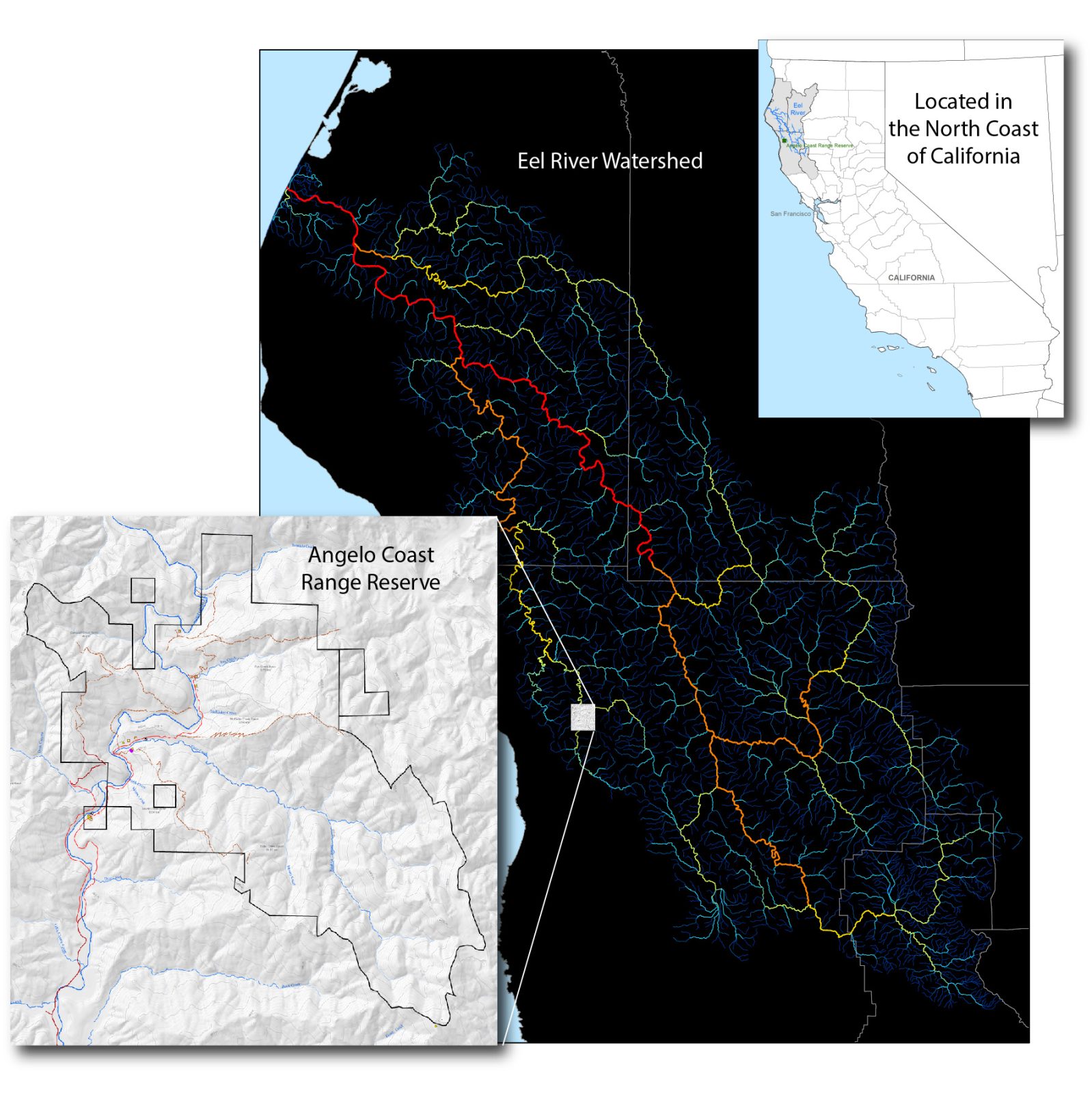
This Reserve was acquired by The Nature Conservancy (TNC) from Heath and Margorie Angelo in 1959. The land was the first Nature Conservancy land holding West of the Mississippi, and for many years, the largest (see site history). Today, it is one of 42 protected natural areas in the UC Nature. It is co-managed for university-level research and teaching by the University of California, Berkeley, and the UC Nature.
Angelo researchers collaborate with local and regional partners who share common interests of understanding the past, current, and future watersheds along the North Coast watersheds, including ways to protect them and use their resources sustainably. Angelo researchers also collaborate with national and international colleagues.
Since Heath and Marjorie Angelo first protected their land in the 1930s, the population of California has increased over six-fold. The Angelo property, along with the 17 sq. km Elder Creek watershed (designated as an area of critical ecological concern by the Bureau of Land Management) together constitute one of the largest continuous tracts of undeveloped coastal conifer forest remaining in California. The reserve protects 5 km of the upper South Fork Eel River, four undisturbed tributary watersheds, mixed conifer broad-leaf forests, meadows on river terraces, and bands of chaparral at higher elevations.
The Angelo Reserve hosts several hundred visitors (faculty, researchers, students and citizens) each year, as well as classes, meetings and workshops. Between 1960-2025, research in the Reserve has produced 497 publications and 36 PhD dissertations or Master’s theses. A number of videos and podcasts have been made about Angelo research. It has been the main field observatory for two NSF Centers and for the Keck Hydrowatch Program. Angelo is currently the core field site for the NSF Eel River Critical Zone Observatory (ERCZO). Research facilities include laboratories and some researcher housing at Goldman Environmental Science Center, rustic housing for ~ 30 persons in Wilderness Lodge Meadow, 3 miles into the reserve, a small watershed (“Rivendell”) that is intensely instrumented for ERCZO hydrology, and a wireless backbone supporting a sensor and communications network.
Angelo Vision
To create a lasting natural laboratory where advanced environmental mapping, sensing, and tracing, disciplined natural history observation, field experimentation, and modeling can be developed, taught, and applied towards discovering the key processes and relationships needed to forecast the co-evolution of the natural ecosystems, water cycles, and climate of California’s North Coast.
Missions
To generate fundamental understanding of the linkages of ecosystems and landscapes in the steep, forested watersheds representative of the region.
To generate high quality long-term data adequate for tests of competing fundamental models of how Nature works.
To provide a test bed for advancing the mapping, sensing and tracing technologies that will drive next-generation environmental research.
To use the Angelo Reserve as a base to explore the entire Eel River ecosystem as a whole, linking Eel watershed outflows to upland and coastal marine environments.
To host meetings, discussions, classes, workshops, and retreats that will bring new approaches, collaborations and commitments to research, education, and land stewardship.
To share critical scientific understanding of the natural ecosystem with those whose actions and choices will affect its resilience over the coming decades.